Collection I · Early Greek philosophy

A small deck.
A world of questions.

From Thales to Zeno, 10 thinkers exploring nature,
change, and what it means to exist.

Meet the minds

The first questions

Origins of thought

Tap or click a card.
Explore the deeper story.

Ordered by approximate birth. Dates are uncertain; Pythagoras and Xenophanes share an estimate, and their relative order is unknown.

Origins of thought01 / 10

Milesian · Miletus

Thales

Say: THAY-leez

Born c. 625 BCE

A limestone arch emerging from a teal sea, with water cascading into rings of ripples.
Water

Archē · first principle

Known for

  • Water as the first principle
  • Geometry traditionally attributed to him
  • A reported eclipse prediction (disputed)
Questions asked

What does everything come from?

Answers proposed

One source, many forms

Thales proposed water as the world's originating principle: a familiar part of nature could explain the whole.

What it changes

Make the world a question

Looking for causes within nature helped make the world something people could investigate, rather than simply accept.

Context & sources for Thales
Reading the card · 01

Milesian · Miletus

Thales

Say: THAY-leez

Questions & answers

The questions paraphrase the problems he explored. The answers summarize his proposals, not settled facts or direct quotations.

  1. Question asked · 1
    What does everything come from?
    Answer proposed

    Thales proposed water as the world's originating principle: a familiar part of nature could explain the whole. [1]

  2. Question asked · 2
    How is the Earth supported?
    Answer proposed

    Aristotle reports that Thales thought Earth floated on water, like wood. This was his proposal, not a modern explanation. [1]

The argument
Aristotle reports that Thales named water as the first principle and thought the earth rested on it. Aristotle's suggested reasons, such as water's role in nourishment, are reconstructions, not Thales' surviving words. [1]
Place in the conversation
Anaximander and Anaximenes continued the Milesian search for an origin. Their answers differed; a direct teacher-pupil chain is uncertain. [2]
What survives
No securely authenticated writing by Thales survives. Later testimony preserves his ideas, and how he explained change remains unclear. His water theory is not modern science. [1]
About the approximate date

Oregon's timeline gives c. 625 BCE; the Internet Encyclopedia of Philosophy uses c. 620. Both are estimates. University of Oregon timeline ↗

English approximation. Capitals mark stress; regional pronunciations vary. Collins pronunciation guide ↗

Read the sources

  1. IEP · Thales of Miletus

    Water, Earth's support, geometry, the eclipse report, and evidence

  2. Stanford · The Milesians

    Ideas, relationships, and limits of the evidence

Checked 2026-10-08

Original conceptual art. A sea-born arch imagines the search for an origin in water. AI-generated for this collection; a modern illustration, not an ancient likeness or reconstruction.

Origins of thought02 / 10

Milesian · Miletus

Anaximander

Say: uh-nak-suh-MAN-der

Born c. 611 BCE

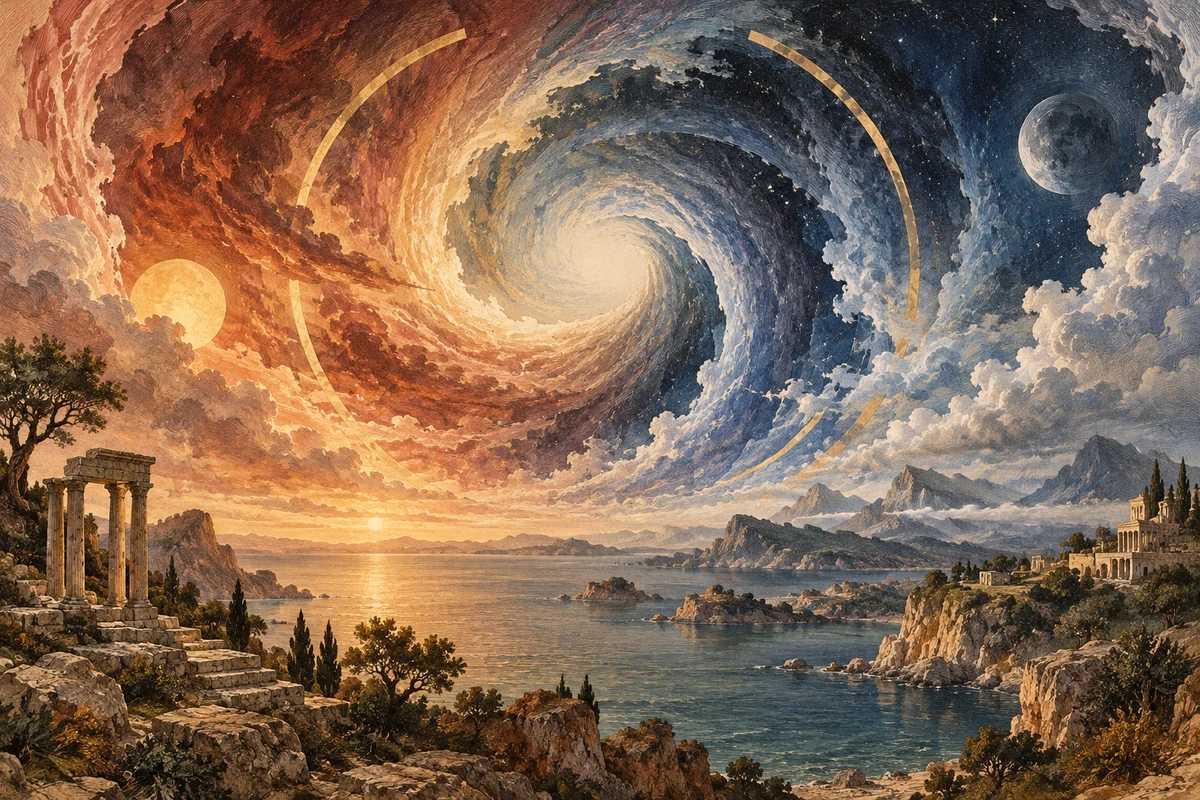
Warm and cool clouds spiral into an open cosmic ring above a Mediterranean coastline.
The boundless

Apeiron · indefinite / unlimited

Known for

  • The apeiron, or boundless origin
  • Earth unsupported at the cosmic center
  • An early world map (reported)
Questions asked

What can give rise to both hot and cold?

Answers proposed

Beyond any one element

He proposed the apeiron, an indefinite source from which opposites such as hot and cold emerge.

What it changes

Widen the possible

The origin of everything might be unlike anything we see. Explaining nature can require a new concept.

Context & sources for Anaximander
Reading the card · 02

Milesian · Miletus

Anaximander

Say: uh-nak-suh-MAN-der

Questions & answers

The questions paraphrase the problems he explored. The answers summarize his proposals, not settled facts or direct quotations.

  1. Question asked · 1
    What can give rise to both hot and cold?
    Answer proposed

    He proposed the apeiron, an indefinite source from which opposites such as hot and cold emerge. [1]

  2. Question asked · 2
    Why doesn't the Earth fall?
    Answer proposed

    Aristotle reports an argument from symmetry: Earth sits at the universe's center, with no reason to move in one direction rather than another. [1]

The argument
Instead of choosing water or another familiar material, Anaximander proposed an indefinite origin. Later reports describe hot and cold separating out, with their interactions producing an ordered world. [1]
Place in the conversation
He shares Thales' search for a natural origin. Anaximenes later chose air and supplied a more explicit process of transformation. [2]
What survives
One passage survives through a much later author, Simplicius. Its exact boundaries and meaning are disputed. The apeiron is not an ancient statement of the Big Bang. [1]
About the approximate date

Oregon's timeline gives c. 611 BCE; the Internet Encyclopedia of Philosophy rounds to c. 610. The precision is uncertain. University of Oregon timeline ↗

English approximation. Capitals mark stress; regional pronunciations vary. Collins pronunciation guide ↗

Read the sources

  1. IEP · Anaximander

    The apeiron, Earth's position, the map report, and evidence

  2. Stanford · The Milesians

    Ideas, relationships, and limits of the evidence

Checked 2026-10-08

Original conceptual art. An open ring and contrasting colors suggest the indefinite and its opposites. AI-generated for this collection; a modern illustration, not an ancient likeness or reconstruction.

Origins of thought03 / 10

Milesian · Miletus

Anaximenes

Say: an-ak-SIM-uh-neez

Born c. 587 BCE

Etched currents of wind encircle a coastal column, with clouds, rain, water, and rocks below.
Air

Rarefaction & condensation

Known for

  • Air as the first principle
  • Change through thinning and thickening
  • Earth held up by air
Questions asked

How can one thing become another?

Answers proposed

Change has a process

Air was his starting point. Thinning and thickening it, he argued, produced fire, clouds, water, earth, and stone.

What it changes

Ask how, as well as what

Naming an origin is only the beginning. A useful explanation also shows how different things arise.

Context & sources for Anaximenes
Reading the card · 03

Milesian · Miletus

Anaximenes

Say: an-ak-SIM-uh-neez

Questions & answers

The questions paraphrase the problems he explored. The answers summarize his proposals, not settled facts or direct quotations.

  1. Question asked · 1
    How can one thing become another?
    Answer proposed

    Air was his starting point. Thinning and thickening it, he argued, produced fire, clouds, water, earth, and stone. [1]

  2. Question asked · 2
    How is the Earth supported?
    Answer proposed

    He pictured Earth as a flat disk held up by air. Air supplies both an origin for the world and a support for Earth in his cosmology. [1]

The argument
In later accounts, thinning air makes fire; increasing its density makes wind, cloud, water, earth, and stones. This gives his theory an explicit mechanism for natural change, though the mechanism is scientifically incorrect. [1]
Place in the conversation
Anaximenes follows Anaximander in the Milesian tradition, but replaces the indefinite origin with air. Whether he was formally Anaximander's pupil is uncertain. [2]
What survives
His work is known through later quotations and reports. Scholars debate whether he thought air persisted inside every substance or actually changed into other materials. [1]
About the approximate date

The approximate birth of c. 587 BCE follows Oregon's timeline. His life dates are poorly established; the IEP places his activity in the mid-sixth century BCE. University of Oregon timeline ↗

English approximation. Capitals mark stress; regional pronunciations vary. Collins pronunciation guide ↗

Read the sources

  1. IEP · Anaximenes

    Air, material changes, Earth's support, and evidence

  2. Stanford · The Milesians

    Ideas, relationships, and limits of the evidence

Checked 2026-10-08

Original conceptual art. Moving air and changing materials evoke his proposed process of transformation. AI-generated for this collection; a modern illustration, not an ancient likeness or reconstruction.
Origins of thought04 / 10

Pythagorean · Samos / Croton

Pythagoras

Say: pih-THAG-uh-rus

Born c. 570 BCE

A golden thread curves between an old olive tree and a young shoot beside a glowing terracotta lamp at dusk.
The soul

Metempsychosis · rebirth of the soul

Known for

  • Rebirth of the soul
  • A philosophical way of life
  • His namesake theorem (attribution disputed)
Questions asked

What happens to us after death?

Answers proposed

A life beyond one body

Early reports attribute to Pythagoras a soul that survives death and can be reborn in another human or animal body.

What it changes

Give ideas a place in life

His community treated philosophy as a way to live together, as well as a set of ideas to discuss.

Context & sources for Pythagoras
Reading the card · 04

Pythagorean · Samos / Croton

Pythagoras

Say: pih-THAG-uh-rus

Questions & answers

The questions paraphrase the problems he explored. The answers summarize his proposals, not settled facts or direct quotations.

  1. Question asked · 1
    What happens to us after death?
    Answer proposed

    Early reports attribute to Pythagoras a soul that survives death and can be reborn in another human or animal body. [1]

  2. Question asked · 2
    How should we live?
    Answer proposed

    He established a disciplined shared life involving ritual and dietary practices. Ancient accounts disagree about the precise rules. [1]

The argument
Pythagoras settled in Croton and attracted followers to a distinctive way of life. Later Pythagoreans developed mathematical accounts of nature; their ideas cannot all be assigned to their founder. [1]
Place in the conversation
Xenophanes mocked his belief in rebirth, while Heraclitus challenged his reputation for wisdom. These thinkers were contemporaries, not steps in a single school. [1]
What survives
Pythagoras wrote nothing. Early testimony is sparse; later accounts contain legends. His role in mathematics, including whether he proved the theorem bearing his name, remains disputed. [1]
About the approximate date

Stanford estimates his birth at c. 570 BCE; Oregon dates his activity to the second half of the sixth century. Xenophanes has the same estimated birth year, so their relative order is unknown. University of Oregon timeline ↗

English approximation. Capitals mark stress; regional pronunciations vary. Collins pronunciation guide ↗

Read the sources

  1. Stanford · Pythagoras

    Rebirth, the way of life, contemporaries, dates, and later legends

Checked 2026-10-08

Original conceptual art. The returning thread suggests continuity across lives. The olive tree is a modern visual metaphor, not a claim about his teaching on plants. AI-generated for this collection; a modern illustration, not an ancient likeness or reconstruction.

Origins of thought05 / 10

Ionian poet · Colophon

Xenophanes

Say: zih-NAH-fuh-neez

Born c. 570 BCE

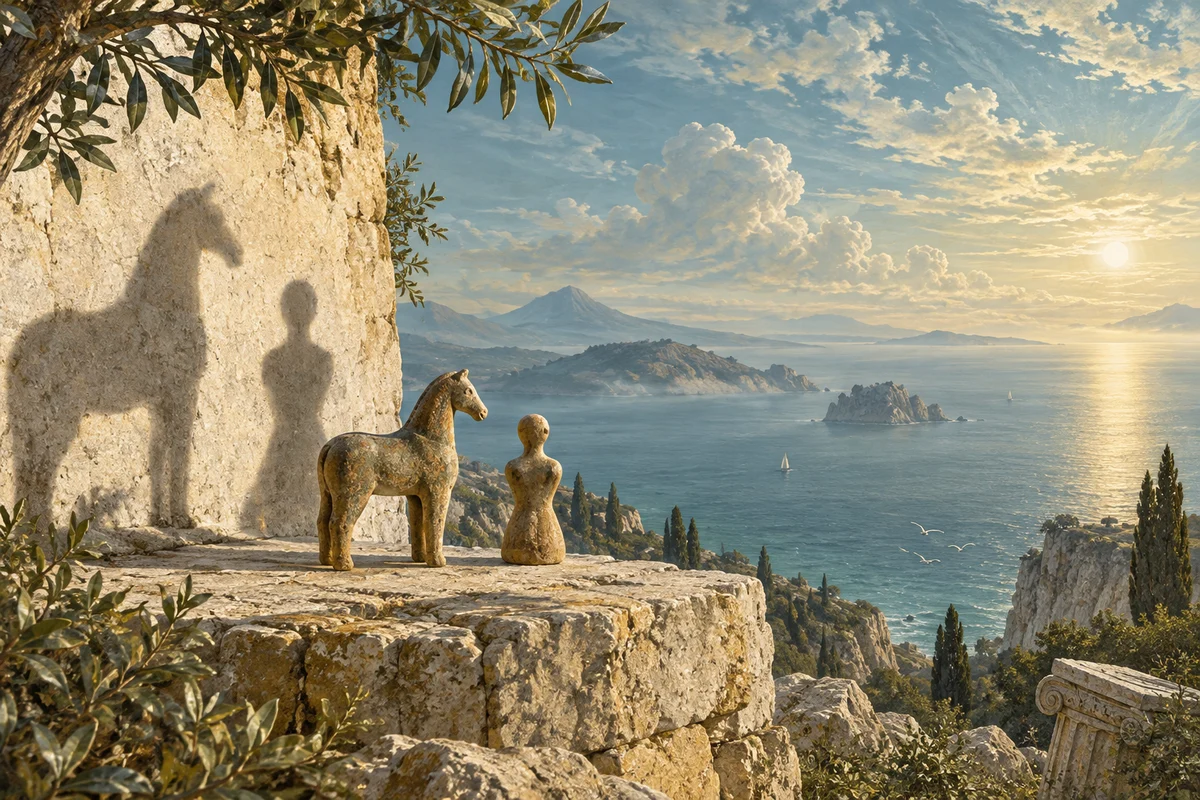
Clay horse and human-shaped forms cast enlarged shadows on a limestone wall above an open sea and sky.
Inquiry

Belief, projection & uncertainty

Known for

  • Criticizing human-shaped gods
  • Questioning certainty about gods and nature
  • Philosophical poetry
Questions asked

Why do our gods look like us?

Answers proposed

Question the familiar image

He challenged people for imagining gods in their own likeness. He proposed a greatest god unlike humans in body or thought.

What it changes

Examine the viewpoint

A familiar belief can reflect the people who hold it. Its familiarity alone does not make it a good explanation.

Context & sources for Xenophanes
Reading the card · 05

Ionian poet · Colophon

Xenophanes

Say: zih-NAH-fuh-neez

Questions & answers

The questions paraphrase the problems he explored. The answers summarize his proposals, not settled facts or direct quotations.

  1. Question asked · 1
    Why do our gods look like us?
    Answer proposed

    He challenged people for imagining gods in their own likeness. He proposed a greatest god unlike humans in body or thought. [1]

  2. Question asked · 2
    Can we be certain about the gods and the cosmos?
    Answer proposed

    His fragments warn that even a correct account may lack certainty. Belief and inquiry remain possible; scholars debate the scope of this warning. [1]

The argument
His poetry criticizes the gods' human forms and misdeeds in traditional stories. Yet he also offers a positive account of the divine; criticism here is not a rejection of all religion. [1]
Place in the conversation
He engaged with Milesian accounts of nature and criticized Pythagoras. Later tradition connects him to Parmenides, but a direct teaching relationship is uncertain. [1]
What survives
Poems survive in fragments quoted by later writers. His greatest god is sometimes read as monotheism, but references to gods in the plural complicate that interpretation. [1]
About the approximate date

Oregon estimates his birth at c. 570 BCE. Pythagoras shares that estimate; neither precise dates nor their relative birth order are established. University of Oregon timeline ↗

English approximation. Capitals mark stress; regional pronunciations vary. Collins pronunciation guide ↗

Read the sources

  1. Stanford · Xenophanes

    Divine images, knowledge, natural inquiry, relationships, and surviving poetry

Checked 2026-10-08

Original conceptual art. Forms and shadows evoke the projection of familiar shapes onto the divine, without depicting a particular deity. AI-generated for this collection; a modern illustration, not an ancient likeness or reconstruction.
Origins of thought06 / 10

Independent · Ephesus

Heraclitus

Say: heh-ruh-KLY-tus

Born c. 540 BCE

A flowing river passes beneath a natural limestone arch at sunset, with a small bronze brazier burning on the bank.
Change

Logos · a shared account / order

Known for

  • Change and the river image
  • Connections between opposites
  • Logos: a shared account or order
Questions asked

How can something stay itself while changing?

Answers proposed

Continuity through change

His river image connects a lasting river with ever-changing water. On one influential reading, some things persist through renewal.

What it changes

Look for the pattern

Change need not erase identity. Understanding something may mean finding the relationships that sustain it over time.

Context & sources for Heraclitus
Reading the card · 06

Independent · Ephesus

Heraclitus

Say: heh-ruh-KLY-tus

Questions & answers

The questions paraphrase the problems he explored. The answers summarize his proposals, not settled facts or direct quotations.

  1. Question asked · 1
    How can something stay itself while changing?
    Answer proposed

    His river image connects a lasting river with ever-changing water. On one influential reading, some things persist through renewal. [1]

  2. Question asked · 2
    How are opposites connected?
    Answer proposed

    He links contrary states within a shared process: waking becomes sleeping, and sleeping becomes waking. Their connection does not make them identical in every respect. [1]

The argument
He presents the cosmos as an ordered process, using fire, rivers, and opposing states as images. Logos names an account or message people must learn to understand, rather than private opinion. [1]
Place in the conversation
He criticized Pythagoras and Xenophanes. His treatment of change offers a useful comparison with Parmenides; a direct exchange between them is not established. [1]
What survives
His book survives in quotations by later authors. The famous claim that one cannot step twice into a river is a later paraphrase; the meaning and extent of his theory of change remain debated. [1]
About the approximate date

Oregon estimates his birth at c. 540 BCE. Stanford more cautiously places his activity around 500 BCE. The displayed birth date is a guide, not a documented event. University of Oregon timeline ↗

English approximation. Capitals mark stress; regional pronunciations vary. Collins pronunciation guide ↗

Read the sources

  1. Stanford · Heraclitus

    River fragments, opposites, logos, contemporaries, and competing interpretations

Checked 2026-10-08

Original conceptual art. Moving water and a sustained flame evoke renewal and order. The scene is an interpretation of ideas, not a site from his life. AI-generated for this collection; a modern illustration, not an ancient likeness or reconstruction.

Origins of thought07 / 10

Eleatic · Elea

Parmenides

Say: par-MEN-uh-deez

Born c. 515 BCE

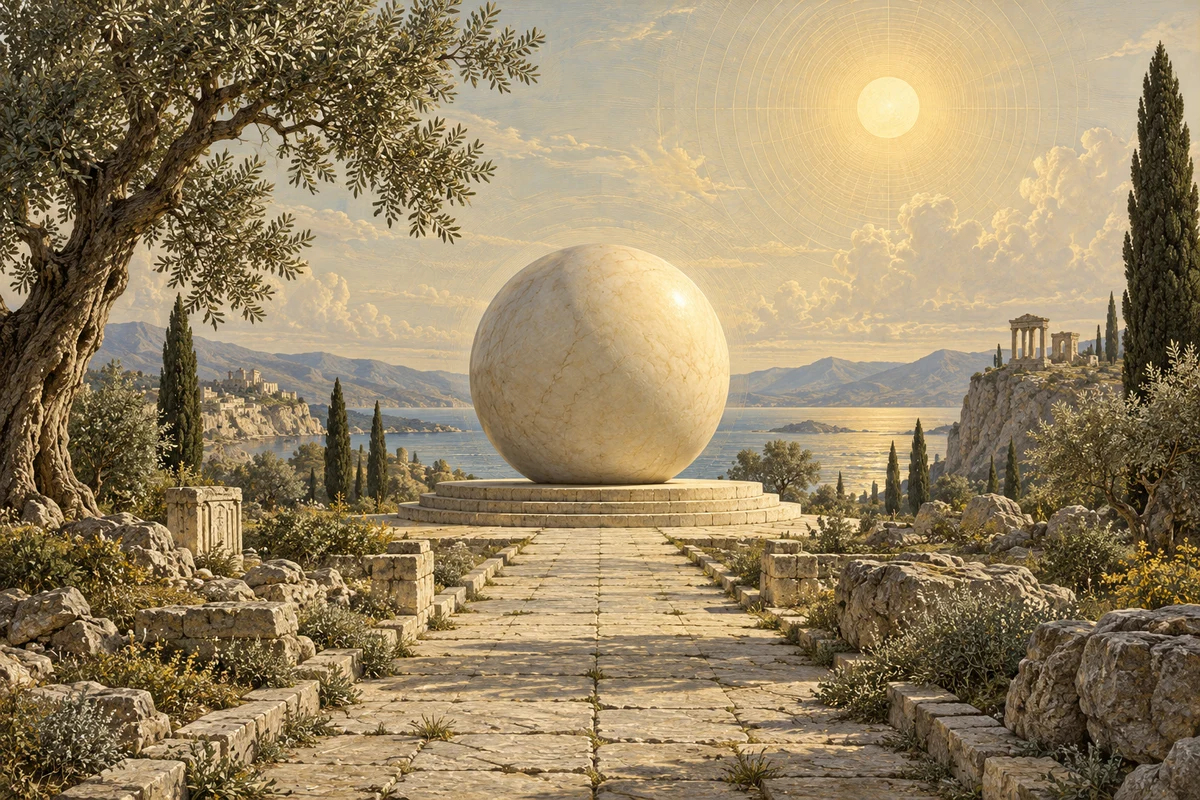
A smooth ivory sphere stands motionless on a plinth at the end of a path in a golden landscape.
Being

To eon · what is

Known for

  • Being as ungenerated and unchanging
  • Reason challenging appearances
  • A poem about truth and mortal opinion
Questions asked

What must be true of what exists?

Answers proposed

Follow the argument

His poem argues that what is cannot arise from what is not: true being is ungenerated, whole, and unchanging.

What it changes

Put appearances on trial

Reason can challenge what seems obvious. Any account of change must explain how its claims fit together.

Context & sources for Parmenides
Reading the card · 07

Eleatic · Elea

Parmenides

Say: par-MEN-uh-deez

Questions & answers

The questions paraphrase the problems he explored. The answers summarize his proposals, not settled facts or direct quotations.

  1. Question asked · 1
    What must be true of what exists?
    Answer proposed

    His poem argues that what is cannot arise from what is not: true being is ungenerated, whole, and unchanging. [1]

  2. Question asked · 2
    Can something come into being from nothing?
    Answer proposed

    His argument rejects being arising from non-being. What truly is therefore has no beginning or destruction. [1]

The argument
A goddess in his poem guides an inquiry into being. Its central argument describes what is as ungenerated, imperishable, continuous, and motionless. The poem also offers an account of the changing cosmos. [1]
Place in the conversation
His arguments made explaining change a central problem for later Greek thinkers. How directly he was responding to the Milesians is debated. [1]
What survives
The poem survives in fragments quoted by later authors. Scholars disagree about how its account of being relates to its cosmology; saying he simply denied the entire visible world is too quick. [1]
About the approximate date

C. 515 BCE is an inference from the ages in Plato's fictionalized meeting with Socrates, not a documented birth date. University of Oregon timeline ↗

English approximation. Capitals mark stress; regional pronunciations vary. Collins pronunciation guide ↗

Read the sources

  1. Stanford · Parmenides

    The poem, dates, influence, and competing interpretations

Checked 2026-10-08

Original conceptual art. The sphere evokes the poem's comparison of complete being to a well-rounded globe. AI-generated for this collection; a modern illustration, not an ancient likeness or reconstruction.
Origins of thought08 / 10

Pluralist · Clazomenae / Athens

Anaxagoras

Say: an-ak-SAG-uh-rus

Born c. 500 BCE

Gold and blue mineral particles form a vast spiral above a stone platform and a quiet Ionian coastline at dawn.
Mind

Nous · cosmic Mind

Known for

  • Mind initiating cosmic rotation
  • A share of everything in everything
  • Natural explanations of eclipses
Questions asked

How did an original mixture become an ordered world?

Answers proposed

Mind sets things in motion

He proposed that an unmixed cosmic Mind began a rotation that separated an original mixture into the world we recognize.

What it changes

Explain the ordering

An account of the world's ingredients also needs to explain what starts their movement and gives them an arrangement.

Context & sources for Anaxagoras
Reading the card · 08

Pluralist · Clazomenae / Athens

Anaxagoras

Say: an-ak-SAG-uh-rus

Questions & answers

The questions paraphrase the problems he explored. The answers summarize his proposals, not settled facts or direct quotations.

  1. Question asked · 1
    How did an original mixture become an ordered world?
    Answer proposed

    He proposed that an unmixed cosmic Mind began a rotation that separated an original mixture into the world we recognize. [1]

  2. Question asked · 2
    Does change create something from nothing?
    Answer proposed

    For him, things form and dissolve as existing ingredients mix and separate. Even after separation, every material mixture retains a share of everything. [2]

The argument
His original mixture contained all ingredients together. Mind remained separate and initiated a vortex. Different proportions explain why a mixture appears to be one kind of thing rather than another. [1]
Place in the conversation
Like Empedocles, he addressed Parmenides' challenge to coming into being. He preserved enduring ingredients while allowing their arrangements to change. [2]
What survives
Fragments and later reports preserve his theory. Scholars debate the nature of his ingredients and how much Mind directs events beyond initiating rotation. His cosmology is not modern physics. [1]
About the approximate date

Stanford estimates his birth at c. 500 BCE from an ancient report of his age in 480 BCE. This remains an approximate reconstruction. University of Oregon timeline ↗

English approximation. Capitals mark stress; regional pronunciations vary. Collins pronunciation guide ↗

Read the sources

  1. Stanford · Anaxagoras

    Mind, cosmic rotation, eclipses, evidence, and approximate dates

  2. IEP · Anaxagoras

    Mixture, change, and the response to Parmenides

Checked 2026-10-14

Original conceptual art. The spiral imagines mixture becoming ordered through rotation. It is a visual metaphor, not an ancient diagram or a modern astronomical model. AI-generated for this collection; a modern illustration, not an ancient likeness or reconstruction.

Origins of thought09 / 10

Pluralist · Acragas, Sicily

Empedocles

Say: em-PED-uh-kleez

Born c. 492 BCE

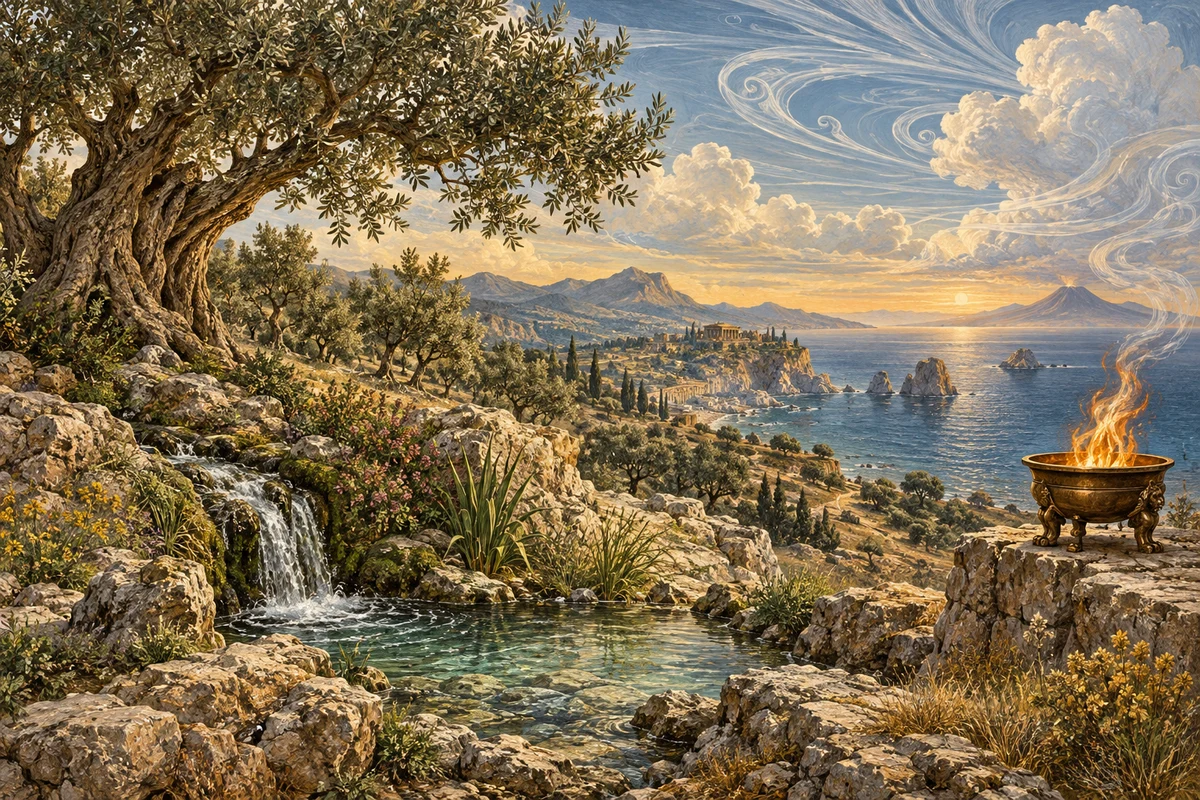
A spring and pool, rocky ground, wind-shaped clouds, and a bronze brazier share a sunlit Sicilian coastal landscape.
Four roots

Roots · Love & Strife

Known for

  • Earth, water, air, and fire as four roots
  • Love and Strife as cosmic forces
  • Rebirth and the kinship of living things
Questions asked

How can things change if their basic ingredients endure?

Answers proposed

New mixtures, lasting roots

He proposed four enduring roots: earth, water, air, and fire. Love and Strife change their combinations to produce the things around us.

What it changes

Look at the combination

Something new can arise through a different mixture of enduring ingredients. Explaining change requires relationships as well as materials.

Context & sources for Empedocles
Reading the card · 09

Pluralist · Acragas, Sicily

Empedocles

Say: em-PED-uh-kleez

Questions & answers

The questions paraphrase the problems he explored. The answers summarize his proposals, not settled facts or direct quotations.

  1. Question asked · 1
    How can things change if their basic ingredients endure?
    Answer proposed

    He proposed four enduring roots: earth, water, air, and fire. Love and Strife change their combinations to produce the things around us. [1]

  2. Question asked · 2
    What drives the world's changes?
    Answer proposed

    Love brings unlike roots together, while Strife separates them into like groups. Their changing influence produces a cosmic cycle; its precise sequence is debated. [1]

The argument
His poems connect a physical account of the roots with religious concerns about purification and rebirth. Love and Strife are cosmic principles, not simply human feelings. [1]
Place in the conversation
He and Anaxagoras offered distinct responses to Parmenides. His teaching about rebirth also belongs in the conversation with Pythagorean traditions. [2]
What survives
His poetry survives in fragments and later testimony, including papyrus discoveries. Scholars dispute how its physical and religious teachings fit together. The four roots are not modern chemical elements. [1]
About the approximate date

The IEP gives c. 492 BCE; other estimates differ. Stanford cautiously places his birth in the early fifth century BCE, so the displayed year is only a guide. University of Oregon timeline ↗

English approximation. Capitals mark stress; regional pronunciations vary. Collins pronunciation guide ↗

Read the sources

  1. Stanford · Empedocles

    The four roots, Love and Strife, poetry, and disputed interpretations

  2. IEP · Empedocles

    Dates, Parmenides, rebirth, and the surviving works

Checked 2026-10-14

Original conceptual art. One landscape brings the four roots into view. Its circular movement suggests combination and separation without depicting a historical site. AI-generated for this collection; a modern illustration, not an ancient likeness or reconstruction.

Origins of thought10 / 10

Eleatic · Elea

Zeno of Elea

Say: ZEE-noh of EE-lee-uh

Born c. 490 BCE

A tortoise follows a limestone coastal path whose bronze markers draw ever closer together toward an arch.
Paradox

Paradox · an argument against common belief

Known for

  • Achilles and the tortoise
  • The arrow and dichotomy paradoxes
  • Arguments challenging plurality
Questions asked

Can Achilles ever catch the tortoise?

Answers proposed

There is always another gap

The paradox says Achilles cannot catch up: whenever he reaches the tortoise's previous position, it has moved ahead again. This challenges our assumptions about motion.

What it changes

Test what seems obvious

A familiar event can conceal difficult assumptions. His arguments made space, time, and infinity lasting subjects of inquiry.

Context & sources for Zeno of Elea
Reading the card · 10

Eleatic · Elea

Zeno of Elea

Say: ZEE-noh of EE-lee-uh

Questions & answers

The questions paraphrase the problems he explored. The answers summarize his proposals, not settled facts or direct quotations.

  1. Question asked · 1
    Can Achilles ever catch the tortoise?
    Answer proposed

    The paradox says Achilles cannot catch up: whenever he reaches the tortoise's previous position, it has moved ahead again. This challenges our assumptions about motion. [1]

  2. Question asked · 2
    How can a journey finish if a distance can always be divided?
    Answer proposed

    The dichotomy requires reaching a halfway point, then another, without end. Its challenge is explaining how infinitely many stages can fit within a finite journey. [2]

The argument
His paradoxes challenge motion and the idea that reality consists of many distinct things. The arrow asks how motion is possible if an arrow occupies its own place at every instant. [1]
Place in the conversation
He was a younger associate of Parmenides. A defense of Parmenides is a traditional explanation of his aims, but his precise purpose remains debated. [2]
What survives
We rely on a few fragments and later reports, especially Aristotle's accounts of motion. Modern mathematics helps explain some puzzles; interpreting their original assumptions remains a philosophical question. [1]
About the approximate date

Stanford estimates c. 490 BCE from the ages in Plato's fictionalized meeting of Zeno, Parmenides, and a young Socrates. It is not a documented birth date. University of Oregon timeline ↗

English approximation. Capitals mark stress; regional pronunciations vary. Collins pronunciation guide ↗

Read the sources

  1. Stanford · Zeno of Elea

    Life, arguments, Parmenides, dates, and the limits of the evidence

  2. Stanford · Zeno's Paradoxes

    Motion, division, infinity, and modern responses

Checked 2026-10-14

Original conceptual art. The tortoise and receding markers evoke the motion paradoxes. The scene is a modern conceptual illustration, not an ancient account of a real race. AI-generated for this collection; a modern illustration, not an ancient likeness or reconstruction.

Take your time. These cards are made for curiosity.

A note from the collection

Old ideas.
Open questions.

These are invitations to think, with a little historical care along the way.

01

Read with context

Early Greek philosophy reaches us through fragments and later reports. Each card's back explains the evidence and links to academic sources.

02

Keep time in perspective

“C.” means “approximately.” Dates use academic estimates, including a University of Oregon timeline. Each back explains its date; overlapping lives make the order a guide to the collection.

03

Bring your own questions

The “modern lens” is a present-day reflection, not a teaching attributed to the philosopher. The original, AI-generated artwork imagines ideas rather than historical likenesses.